
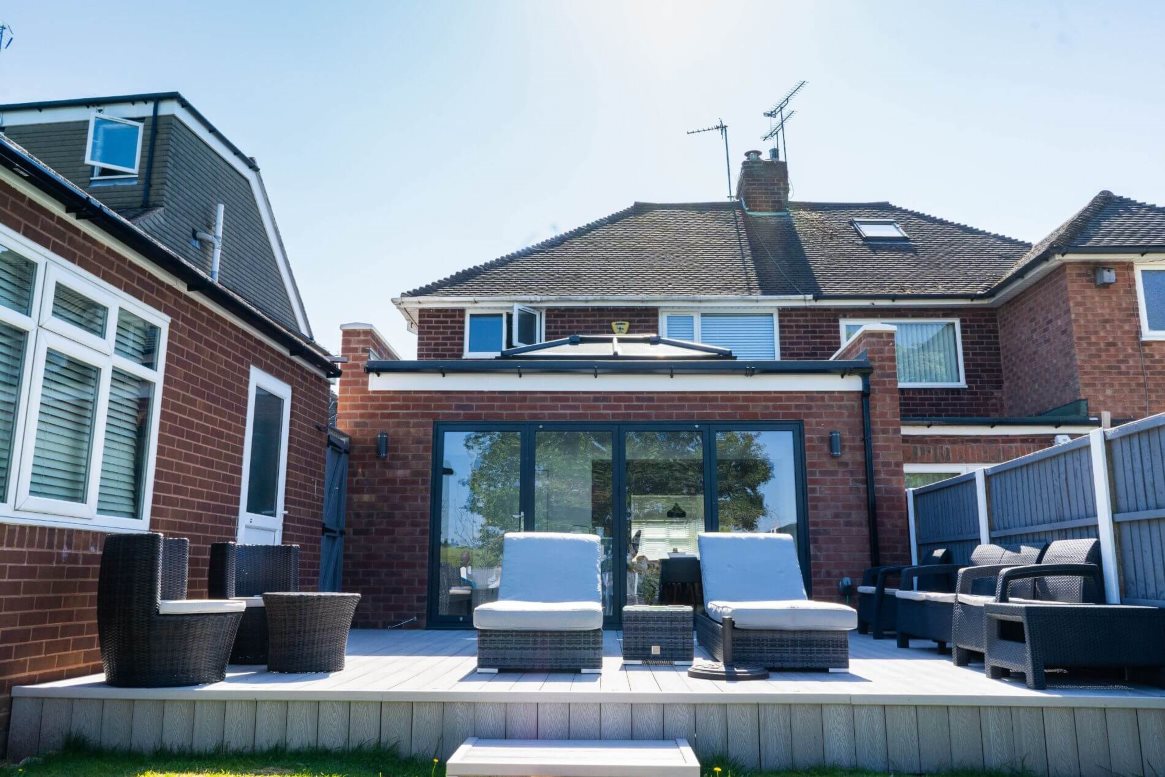
Choosing the right roof for your rear extension isn’t just a structural decision — it completely transforms how your new space feels, functions, and fills with light. From sleek flat rooflights to dramatic lanterns and timeless pitched designs, each option creates a very different living experience. In this guide, we break down the pros, costs, and best uses of each so you can make the right choice for your home.
For many single-storey rear extensions, a flat roof paired with a rooflight or lantern offers the most cost-effective solution without compromising on natural light. Pitched roofs, while a larger investment, provide greater longevity and are often better suited to traditional-style homes. Lanterns can create a striking focal point while softening light across larger spaces, whereas flush rooflights deliver a clean, modern finish with uninterrupted sightlines.
Ultimately, the best choice comes down to your extension’s size and structure, the existing roofline, any planning considerations, and how you want the space to look and feel in everyday use.
What are the main rear extension roof options?
When planning a rear extension, the roof is one of the most important decisions you will make. It shapes the natural light inside, the ceiling height, the structural complexity, and the long-term running costs.
The four most common rear extension roof options are:
- Flat roofs – with or without glazing
- Pitched roofs – lean-to, gable, or hipped
- Roof lanterns – a raised glazed structure sitting on a flat roof deck
- Rooflights (flat skylights) – flush-fitting or low-profile glazed panels
Flat roof rear extensions
Despite the name, a flat roof is never truly flat. Building regulations require a minimum fall of 1:40 so that rainwater drains away efficiently rather than pooling on the surface. Get this wrong and you face premature deterioration, leaks, and a call to your building surveyor.
The structural layer consists of timber joists, typically 200 x 50mm, 175 x 50mm, or 150 x 50mm sections placed at 400mm to 600mm centres, depending on the span. Where spans exceed 2.5 metres, additional strutting or noggins are required between the joists to prevent twisting. On longer spans, a steel beam is often needed to carry the flat roof structure and the load of any first-floor wall above the opening you make into the house.
Best for: Flat roofs
- Terraced and semi-detached properties where first-floor windows limit pitch options
- Homeowners wanting the most cost-effective single-storey structure
- Modern, contemporary aesthetics
- Extensions where ceiling consistency and clean lines matter
- Projects where a lantern or rooflight will provide the natural light overhead
Pitched roof rear extensions
A pitched roof on a rear extension typically takes one of three forms:
Lean-to (mono-pitch): The simplest pitched option. A single slope falls away from the house at an angle determined by the available height.
Gable (double pitch): A ridge runs along the centre with two slopes meeting at the top. This suits wider extensions and gives a more traditional, house-like appearance.
Hipped: All four sides slope inward. This is less common on rear extensions but is sometimes specified to avoid the need for a gable wall close to a boundary.
Best for: Pitched roofs
- Period homes, Victorian and Edwardian terraces where character matters
- Properties in or near conservation areas where planning approval is more sensitive
- Smaller rear extensions where vaulted ceilings and maximum headspace are priorities
- Homeowners who want the longest possible roof lifespan with lowest maintenance
- Projects where the roofline needs to match the existing house visually
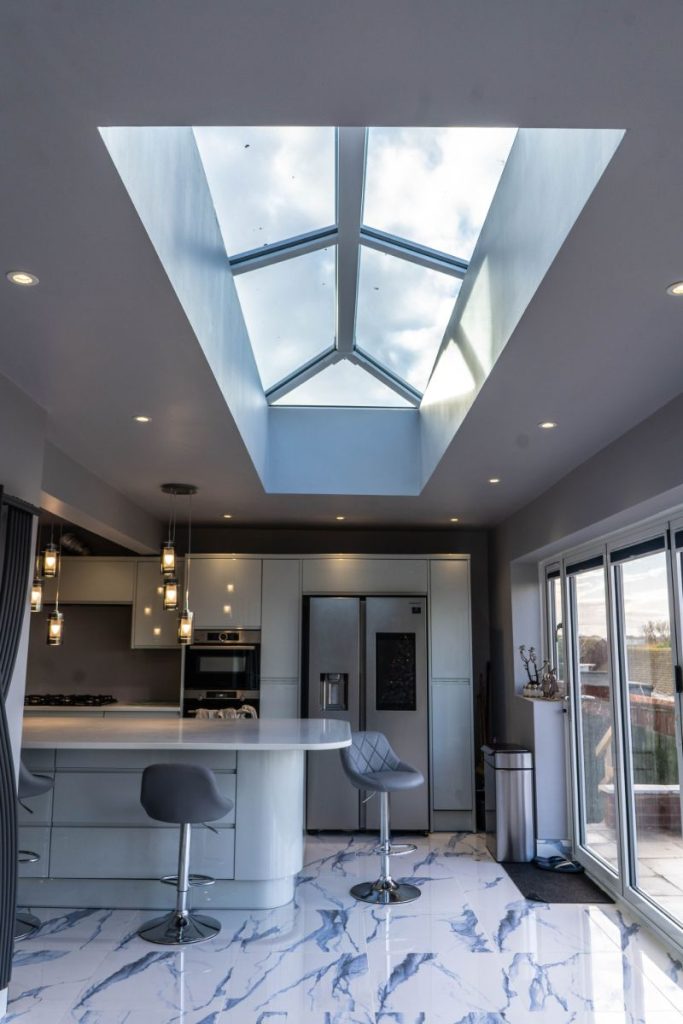
Roof lanterns on flat roof extensions
A roof lantern is a raised glazed structure that sits on top of a flat roof deck, formed with a pitched frame on four sides so that glazing slopes inward to a central ridge. It functions like a miniature pitched glass roof sitting proud of the main flat roof, letting daylight flood in from above at multiple angles simultaneously.
Best for: Roof lanterns
- Wide, deep open-plan extensions where the centre of the room is far from perimeter glazing
- Homeowners who want a statement architectural feature overhead
- Traditional and period properties where a lantern’s pitched profile complements the existing aesthetic
- Kitchen-diners, dining rooms, and large living-kitchen hybrids
- Spaces where diffused, multi-directional light is preferred over a sharp spotlight
Flat rooflights (skylights) on flat roof extensions
A flat rooflight sits close to or flush with the roof surface. The frame is minimal and the glazing is either completely horizontal or pitched very slightly – typically 5 to 15 degrees – to aid drainage. The result externally is almost invisible from ground level, which suits modern, clean architectural lines beautifully.
Best for: Flat rooflights
- Contemporary extensions with clean, minimal design language
- Homeowners who want to see the sky directly, including stars at night
- Extensions where the architectural preference is for flush, low-profile glazing
- Side return extensions or narrow spaces where a lantern’s raised profile would look disproportionate
- Projects where multiple small units across a wide roof are more effective than one central lantern
Roof option comparison table
The following table summarises the key practical differences between the four main rear extension roof options for a typical single-storey build.
| Factor | Flat roof (no glazing) | Pitched roof + skylights | Roof lantern | Flat rooflights |
| Typical lifespan | 25-30 years | 50-75 years | 20-30 years (glazing) | 20-30 years (glazing) |
| Light quality | Low (perimeter only) | High, directional | High, diffused | High, direct |
| Ceiling height feel | Consistent, moderate | Vaulted at apex | Consistent + raised centre | Consistent |
| Drainage complexity | Medium | Low | Low (4-sided pitch) | High (fall-dependent) |
| Structural demand | Low-medium | Medium-high | Low-medium | Low-medium |
| Summer overheating risk | Low | Medium | High (south-facing) | High (south-facing) |
| Maintenance demand | Medium | Low | Low-medium | Low |
| Cleaning access | Easy | Moderate | Moderate | Easy |
| Planning sensitivity | Low-medium | Low | Low | Low |
| Relative cost | Lowest | Highest | Medium-high | Medium |
Which rear extension roof should you choose?
Use this summary to match your situation to the most suitable option:
Choose a flat roof if you have first-floor windows that limit your pitch options, you want the most cost-effective structure, or you prefer a clean modern aesthetic. Add a rooflight or lantern for natural light from above.
Choose a pitched roof if your property is a period home or in a conservation area, you want the longest possible lifespan, or you want a vaulted ceiling with integrated skylights in a smaller extension.
Choose a roof lantern if you are building a wide, deep open-plan kitchen-diner, you want a statement feature overhead, or your property has a traditional character that the lantern’s pitched profile complements.
Choose flat rooflights if you prefer a minimal, contemporary look, you want to see the sky directly from below, or you are fitting multiple units across a wider roof where a single lantern would not span the full space.
Ready to plan your rear extension in Birmingham or the West Midlands?
At West Midlands Home Improvements, we design and build rear extensions across Birmingham and the wider West Midlands, handling every stage from architectural drawings and planning applications through to the final construction. Our team will help you choose the right roof structure for your property, your budget, and the way you want to live in the new space.
We offer flexible finance options including interest-free credit for up to three years, so budget does not have to stand between you and the extension your home deserves.
Explore our house extensions page to see what we have delivered across the region, or browse our single storey extension and open-plan extension ideas guides for further inspiration.
To book your free no-obligation consultation, contact the WMHI team today.