
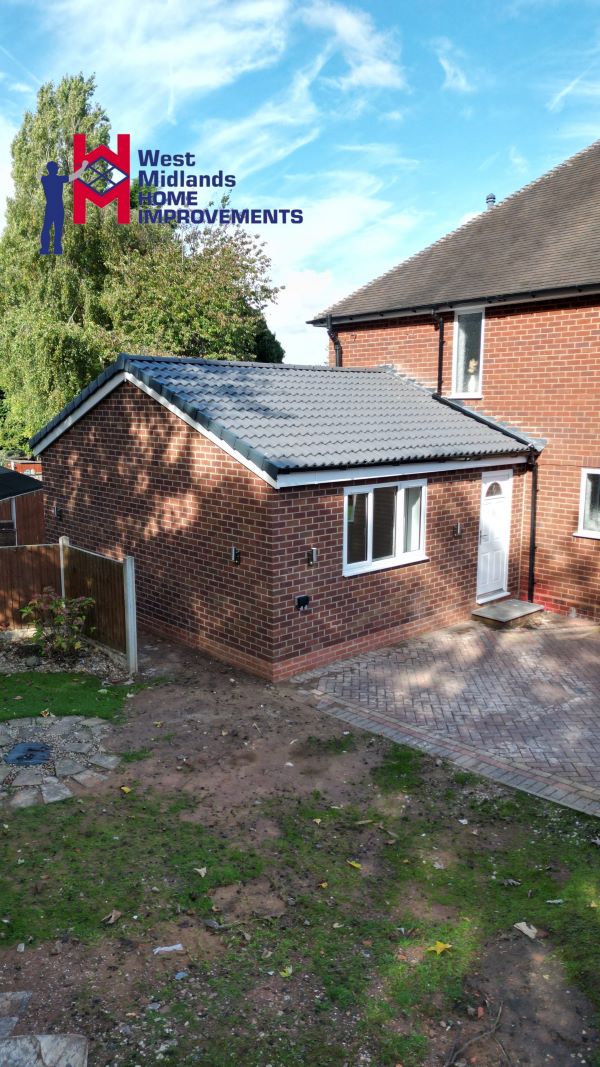
A garage utility conversion turns an underused concrete shell into a hardworking laundry room and downstairs WC. Most attached garages qualify under permitted development, so no planning application is needed, but building regulations approval is always required.
A single garage (typically 5.5m x 2.7m) gives you enough floor area to fit washing appliances, a generous worktop run, storage for bins and cleaning products, and a partitioned WC, all within budget that sits well below the cost of a full extension.
Read on for layout strategies, compliance requirements, appliance placement rules, and WC design guidance.
Is converting a garage into a utility room a good idea?
If you’re looking to declutter the kitchen and have garage sitting used, then the simple answer is yes. The garage is already within the thermal envelope of the house in most semi-detached and terraced properties, the drainage stack is nearby, and the slab floor is already there. You are not building new space, you are activating space you already own.
The practical case is strong:
- Removes appliances and cleaning clutter from the kitchen
- Creates a dedicated drying, ironing, and laundry-sorting zone
- Adds a downstairs WC, which makes a home more attractive to buyers and more practical for families
- Costs a fraction of a single-storey extension while delivering comparable day-to-day value
How long will installation take?
A garage utility conversion with a partitioned WC typically completes within two to three weeks, compared to eight to twelve weeks for a comparable extension footprint.
Does a garage utility conversion need planning permission?
In most cases, no. Most attached garage conversions in the UK fall under permitted development, meaning no formal planning application is needed, provided the use remains ancillary to the main dwelling.
However, you must check two things before work starts:
- Are there conditions on your original planning consent requiring the garage to remain for parking? Some estates, particularly new builds across Birmingham, carry exactly this restriction. If that condition exists, you need to apply to remove or vary it before proceeding.
- Has an Article 4 direction removed permitted development rights on your street? This is more common in conservation areas and certain high-density suburbs.
Even where no planning permission is needed, an LDC (Lawful Development Certificate) is worth obtaining as written proof that the conversion is lawful. This protects you when selling.
Building regulations: What applies to a garage utility and WC?
Building regulations approval is always required for a garage conversion, regardless of whether planning permission is needed. This is not optional and cannot be bypassed. A building control inspector will visit at key stages, and you will receive a completion certificate at the end, which your conveyancer will need when you sell.
The Approved Documents that apply directly to a utility and WC conversion are:
| Approved Document | What it covers in a utility/WC context |
| Part A (Structure) | Lintel over former garage door opening; foundations below any new masonry |
| Part B (Fire safety) | Smoke alarms on the main circuit; fire-resisting door between garage and house |
| Part C (Moisture) | Damp-proof membrane to floor; tanking or DPC to walls |
| Part F (Ventilation) | Background ventilation of at least 5,000 mm² for a wet room; extract fan at 15 l/s for a utility/WC |
| Part G/H (Drainage) | Compliant waste runs, correct falls, traps, and rodding access for WC and appliances |
| Part L (Energy) | Insulation to floor, walls, and roof to meet current U-value targets |
| Part P (Electrics) | All electrical work notified and certified by a competent person |
The most common compliance failures on garage utility conversions are inadequate floor insulation and insufficient mechanical extraction. Both are easy to get right at build stage and expensive to remedy afterwards.
Designing the WC within a garage conversion
Minimum dimensions and clearances
The minimum footprint for a compliant WC cubicle in a garage conversion is 900mm wide x 1,200mm deep (measured to the inside face of walls), though 1,000mm x 1,400mm is significantly more comfortable and is strongly recommended if space allows.
Required clearances:
| Element | Minimum clearance |
| In front of the toilet pan | 600 mm (to door or opposite wall) |
| To the side of the basin | 200 mm (to wall or obstacle) |
| Door swing into the room | Must not block access to the WC or basin |
| Door swing out into the utility | Coordinate with appliance door swings |
An outward-opening door is generally preferred for a small WC because it keeps the full internal footprint available. If the utility is narrow, a sliding or pocket door eliminates the swing conflict altogether.
Plumbing and drainage: The practical decisions
Where will the WC drain go?
The soil pipe from the new WC must connect to the existing foul drain. In most properties, the underground drain runs across the rear of the house under the garden, and the manhole cover is visible outside.
Your builder must check whether the garage is built over or near a public sewer. If it is, a build-over agreement with Severn Trent Water will be required before any new connections are made. This is a routine process but must be factored into the programme and is something West Midlands Home Improvements can support you with.
Hot and cold water supply to the utility
The utility sink and washing machine need a cold supply. If you want a hot tap at the sink, you will need either:
- A branch from the existing hot water circuit (acceptable if the pipe run is short)
- An under-counter instantaneous electric water heater (avoids wasted heat in a long pipe run)
How much does a garage utility conversion with a WC cost?
Cost varies considerably based on specification and existing garage condition, but the table below reflects typical ranges for West Midlands properties in 2025:
| Scope element | Typical cost range |
| Strip-out, floor prep, DPM | £500 – £900 |
| Floor insulation and screed or board | £800 – £1,500 |
| Wall insulation, stud work, boarding | £900 – £1,600 |
| Garage door infill (brick/block with window) | £1,200 – £2,200 |
| Partition wall (utility/WC separation) | £400 – £700 |
| Plumbing (utility sink, appliance connections, WC) | £1,500 – £3,500 |
| Drainage connection / soil pipe | £600 – £1,800 |
| Electrical (full fit, certified) | £800 – £1,600 |
| Tiling (WC full-height + utility splashback) | £600 – £1,400 |
| Fitted base units, worktop, and storage | £1,500 – £4,000 |
| Plastering, decoration | £600 – £1,100 |
| Building control fees | £300 – £600 |
| Total typical range | £9,700 – £20,900 |
Specifications with high-end joinery, underfloor heating, bespoke tiling, or a more complex drainage connection will sit above this range. A basic conversion using mid-market materials lands in the lower half. WMHI offers interest-free finance options spread over up to three years for qualifying homeowners.
Ready to plan your garage utility conversion in Birmingham or the West Midlands?
At WMHI, we are a professional design-and-build company, meaning we manage every stage of your garage-to-utility and WC conversion from start to finish. Our process begins with an initial design consultation, followed by a detailed survey and support with any required planning or building applications. From there, our experienced team delivers the full build and oversees final sign-off, ensuring everything meets the highest standards.
We also provide a dedicated aftercare service, so if any issues arise after completion, we can quickly arrange for them to be resolved. Throughout the project, our in-house specialists handle all key trades—including plumbing, electrical, and joinery—removing the need to coordinate multiple contractors and ensuring a smooth, efficient transformation of your space.
We offer a free consultation to homeowners across Birmingham, West Bromwich, Walsall, Solihull, Wolverhampton, Coventry, and the surrounding areas.
Contact West Midlands Home Improvements today, and we will assess your garage, confirm your permitted development status, and provide a detailed, itemised quote with no obligation.
You can also browse our case studies to see completed garage conversion projects, or read our garage conversion ideas guide for further inspiration on how to use the space.